


Note
Go to the end to download the full example code. or to run this example in your browser via Binder
Depth based classification#
This example shows the use of the depth based classification methods
applied to the Berkeley Growth Study data. An attempt to show the
differences and similarities between
MaximumDepthClassifier,
DDClassifier,
and DDGClassifier is made.
# Author: Pedro Martín Rodríguez-Ponga Eyriès
# License: MIT

# sphinx_gallery_thumbnail_number = 5
The Berkeley Growth Study data contains the heights of 39 boys and 54 girls from age 1 to 18 and the ages at which they were collected. Males are assigned the numeric value 0 while females are assigned a 1. In our comparison of the different methods, we will try to learn the sex of a person by using its growth curve.
from skfda.datasets import fetch_growth

X_df, y_df = fetch_growth(return_X_y=True, as_frame=True)
X = X_df.iloc[:, 0].array
target = y_df.array
categories = target.categories
y = target.codes
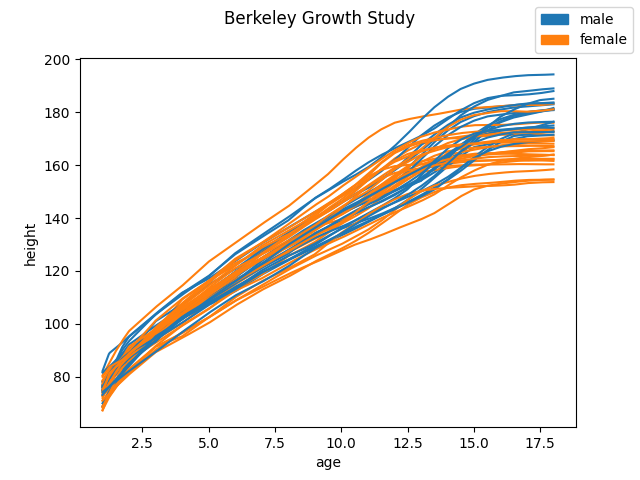
As in many ML algorithms, we split the dataset into train and test. In this graph, we can see the training dataset. These growth curves will be used to train the model. Hence, the predictions will be data-driven.
import matplotlib.pyplot as plt
from sklearn.model_selection import train_test_split

X_train, X_test, y_train, y_test = train_test_split(
    X,
    y,
    test_size=0.5,
    stratify=y,
    random_state=0,
)

# Plot samples grouped by sex
X_train.plot(group=y_train, group_names=categories)
plt.show()
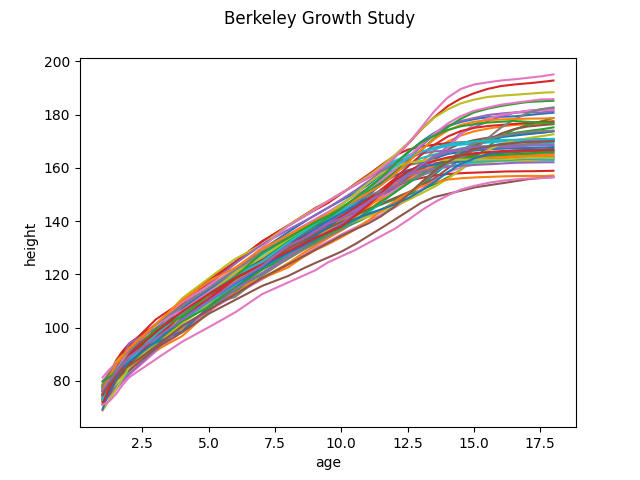
Below are the growth graphs of those individuals that we would like to classify. Some of them will be male and some female.
X_test.plot()
plt.show()
As said above, we are trying to compare three different methods:
MaximumDepthClassifier,
DDClassifier, and
DDGClassifier. They all use a
depth which in our example is
ModifiedBandDepth for consistency. With
this depth we can create a DDPlot.
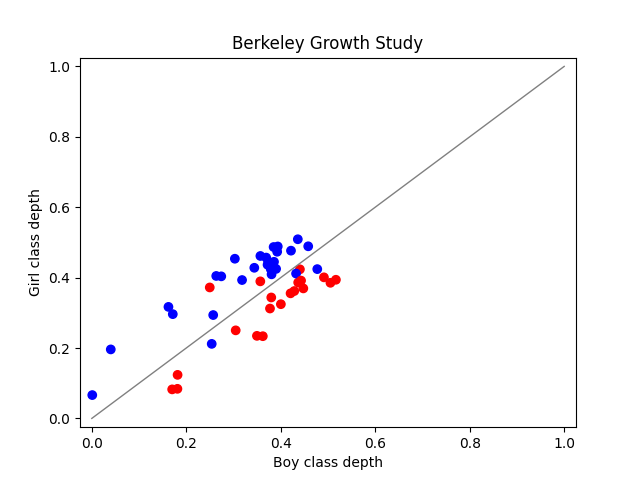
In a DDPlot, a growth curve is
mapped to \([0,1]\times[0,1]\) where the first coordinate corresponds
to the depth in the class of all boys and the second to that of all girls.
Note that the dots will be blue if the true sex is female and red otherwise.
Below we can see how a DDPlot is
used to classify with
MaximumDepthClassifier. In this case it is
quite straighforward, a person is classified to the class where it is
deeper. This means that if a point is above the diagonal it is a girl and
otherwise it is a boy.
import numpy as np
from matplotlib.colors import ListedColormap

from skfda.exploratory.depth import ModifiedBandDepth
from skfda.exploratory.visualization import DDPlot
from skfda.ml.classification import MaximumDepthClassifier

max_depth_classifier = MaximumDepthClassifier(depth_method=ModifiedBandDepth())
max_depth_classifier.fit(X_train, y_train)
print(max_depth_classifier.predict(X_test))
print(f"The score is {max_depth_classifier.score(X_test, y_test):2.2%}")

fig, ax = plt.subplots()

cmap_bold = ListedColormap(["#FF0000", "#0000FF"])

index = y_train.astype(bool)
DDPlot(
    fdata=X_test,
    dist1=X_train[np.invert(index)],
    dist2=X_train[index],
    depth_method=ModifiedBandDepth(),
    axes=ax,
    c=y_test,
    cmap_bold=cmap_bold,
    x_label="Boy class depth",
    y_label="Girl class depth",
).plot()
plt.show()
[0 0 0 0 0 0 1 1 1 1 0 1 0 0 0 1 0 1 0 1 1 1 0 1 1 0 0 0 1 1 1 1 1 0 1 1 0
 0 1 1 1 0 0 1 1 1 1]
The score is 89.36%
We can see that we have used the classification predictions to compute the score (obtained by comparing to the real known sex). This will also be done for the rest of the classifiers.
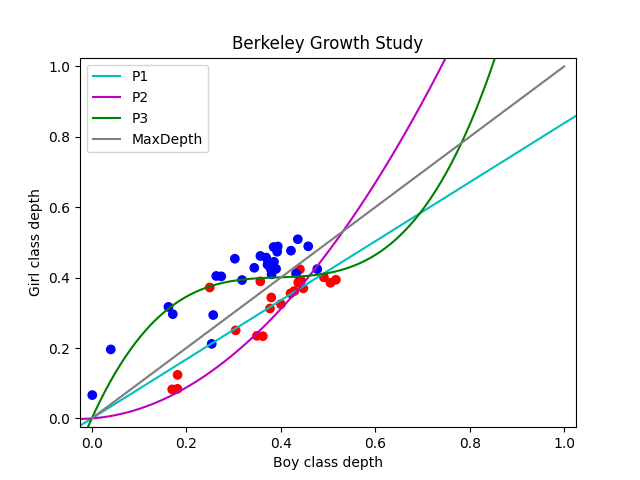
Next we use DDClassifier with polynomes
of degrees one, two, and three. Here, if a point in the
DDPlot is above the polynome,
the classifier will predict that it is a girl and otherwise, a boy.
from skfda.ml.classification import DDClassifier

dd1_classifier = DDClassifier(degree=1, depth_method=ModifiedBandDepth())
dd1_classifier.fit(X_train, y_train)
print(dd1_classifier.predict(X_test))
print(f"The score is {dd1_classifier.score(X_test, y_test):2.2%}")
[0 0 1 0 1 1 1 1 1 1 1 1 1 0 0 1 0 1 0 1 1 1 1 1 1 0 0 1 1 1 1 1 1 1 1 1 0
 0 1 1 1 0 0 1 1 1 1]
The score is 80.85%
dd2_classifier = DDClassifier(degree=2, depth_method=ModifiedBandDepth())
dd2_classifier.fit(X_train, y_train)
print(dd2_classifier.predict(X_test))
print(f"The score is {dd2_classifier.score(X_test, y_test):2.2%}")
[0 0 1 1 1 1 1 1 1 1 1 1 1 1 0 1 0 1 1 1 1 1 1 1 1 0 1 1 1 1 1 1 1 0 1 1 1
 1 1 1 1 0 1 1 1 1 1]
The score is 68.09%
dd3_classifier = DDClassifier(degree=3, depth_method=ModifiedBandDepth())
dd3_classifier.fit(X_train, y_train)
print(dd3_classifier.predict(X_test))
print(f"The score is {dd3_classifier.score(X_test, y_test):2.2%}")
[0 0 1 0 0 1 1 1 1 1 0 1 0 0 0 1 0 1 0 0 1 1 0 1 0 0 0 0 0 1 1 0 1 1 1 1 0
 0 1 1 1 0 0 1 1 0 1]
The score is 89.36%
from matplotlib.axes import Axes


def plot_boundaries(ax: Axes) -> None:
    """Plot the boundaries of the DD classifier with different degrees."""
    margin = 0.025
    ts = np.linspace(- margin, 1 + margin, 100)
    pol1 = ax.plot(
        ts,
        np.polyval(dd1_classifier.poly_, ts),
        "c",
        label="Polynomial",
    )[0]
    pol2 = ax.plot(
        ts,
        np.polyval(dd2_classifier.poly_, ts),
        "m",
        label="Polynomial",
    )[0]
    pol3 = ax.plot(
        ts,
        np.polyval(dd3_classifier.poly_, ts),
        "g",
        label="Polynomial",
    )[0]
    max_depth = ax.plot(
        [0, 1],
        color="gray",
    )[0]

    ax.legend([pol1, pol2, pol3, max_depth], ["P1", "P2", "P3", "MaxDepth"])

fig, ax = plt.subplots()
plot_boundaries(ax)

DDPlot(
    fdata=X_test,
    dist1=X_train[np.invert(index)],
    dist2=X_train[index],
    depth_method=ModifiedBandDepth(),
    axes=ax,
    c=y_test,
    cmap_bold=cmap_bold,
    x_label="Boy class depth",
    y_label="Girl class depth",
).plot()
plt.show()
DDClassifier used with
KNeighborsClassifier.
from sklearn.neighbors import KNeighborsClassifier

from skfda.ml.classification import DDGClassifier

ddg_classifier = DDGClassifier(
    depth_method=ModifiedBandDepth(),
    multivariate_classifier=KNeighborsClassifier(n_neighbors=5),
)
ddg_classifier.fit(X_train, y_train)
print(ddg_classifier.predict(X_test))
print(f"The score is {ddg_classifier.score(X_test, y_test):2.2%}")
[1 0 1 1 0 1 1 1 1 1 0 1 0 0 0 1 0 1 0 1 1 1 0 1 1 0 1 0 1 1 1 1 1 0 1 1 0
 0 1 1 1 1 0 1 1 1 1]
The score is 85.11%
The other elements of the graph are the decision boundaries:
Boundary |
Classifier |
|---|---|
MaxDepth |
MaximumDepthClassifier |
P1 |
DDClassifier with degree 1 |
P2 |
DDClassifier with degree 2 |
P3 |
DDClassifier with degree 3 |
NearestClass |
DDGClassifier with nearest neighbors |
from skfda.preprocessing.feature_construction import PerClassTransformer

pct = PerClassTransformer(ModifiedBandDepth(), array_output=True)
X_train_trans = pct.fit_transform(X_train, y_train)
X_train_trans = X_train_trans.reshape(len(categories), X_train.shape[0]).T

knn = KNeighborsClassifier(n_neighbors=5)
knn.fit(X_train_trans, y_train)

h = 0.01  # step size in the mesh

# Create color maps
cmap_light = ListedColormap(["#FFAAAA", "#AAAAFF"])

# Plot the decision boundary. For that, we will assign a color to each
# point in the mesh [x_min, x_max]x[y_min, y_max].
x_min, x_max = X_train_trans[:, 0].min() - 1, X_train_trans[:, 0].max() + 1
y_min, y_max = X_train_trans[:, 1].min() - 1, X_train_trans[:, 1].max() + 1
xx, yy = np.meshgrid(
    np.arange(x_min, x_max, h),
    np.arange(y_min, y_max, h),
)
Z = knn.predict(np.c_[xx.ravel(), yy.ravel()])

# Put the result into a color plot
Z = Z.reshape(xx.shape)

fig, ax = plt.subplots()
ax.pcolormesh(xx, yy, Z, cmap=cmap_light, shading="auto")

plot_boundaries(ax)
DDPlot(
    fdata=X_test,
    dist1=X_train[np.invert(index)],
    dist2=X_train[index],
    depth_method=ModifiedBandDepth(),
    axes=ax,
    c=y_test,
    cmap_bold=cmap_bold,
    x_label="Boy class depth",
    y_label="Girl class depth",
).plot()
plt.show()

In the above graph, we can see the obtained classifiers from the train set. The dots are all part of the test set and have their real color so, for example, if they are blue it means that the true sex is female. One can see that none of the built classifiers is perfect.
Next, we will use DDGClassifier together
with a neural network: MLPClassifier.
from sklearn.neural_network import MLPClassifier

ddg_classifier = DDGClassifier(
    depth_method=ModifiedBandDepth(),
    multivariate_classifier=MLPClassifier(
        solver="lbfgs",
        alpha=1e-5,
        hidden_layer_sizes=(6, 2),
        random_state=1,
    ),
)
ddg_classifier.fit(X_train, y_train)
print(ddg_classifier.predict(X_test))
print(f"The score is {ddg_classifier.score(X_test, y_test):2.2%}")
[0 0 0 0 0 0 1 1 1 1 0 1 0 0 0 1 0 1 0 1 1 1 0 1 1 0 0 0 1 1 1 1 1 0 1 1 0
 0 1 1 1 0 0 1 1 1 1]
The score is 89.36%
knn = KNeighborsClassifier(n_neighbors=5)
mlp_classifier = MLPClassifier(
    solver="lbfgs",
    alpha=1e-5,
    hidden_layer_sizes=(6, 2),
    random_state=1,
)
knn.fit(X_train_trans, y_train)
mlp_classifier.fit(X_train_trans, y_train)

Z1 = knn.predict(np.c_[xx.ravel(), yy.ravel()])
Z2 = mlp_classifier.predict(np.c_[xx.ravel(), yy.ravel()])

Z1 = Z1.reshape(xx.shape)
Z2 = Z2.reshape(xx.shape)

fig, axes = plt.subplots(1, 2, sharex=True, sharey=True)

axes[0].pcolormesh(xx, yy, Z1, cmap=cmap_light, shading="auto")
axes[1].pcolormesh(xx, yy, Z2, cmap=cmap_light, shading="auto")

DDPlot(
    fdata=X_test,
    dist1=X_train[np.invert(index)],
    dist2=X_train[index],
    depth_method=ModifiedBandDepth(),
    axes=axes[0],
    c=y_test,
    cmap_bold=cmap_bold,
    x_label="Boy class depth",
    y_label="Girl class depth",
).plot()

DDPlot(
    fdata=X_test,
    dist1=X_train[np.invert(index)],
    dist2=X_train[index],
    depth_method=ModifiedBandDepth(),
    axes=axes[1],
    c=y_test,
    cmap_bold=cmap_bold,
    x_label="Boy class depth",
    y_label="Girl class depth",
).plot()

for ax in axes:
    ax.label_outer()

plt.show()
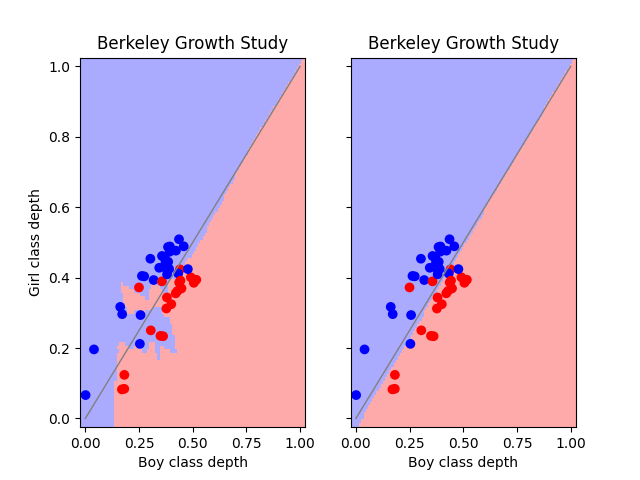
We can compare the behavior of two
DDGClassifier based classifiers. The
one on the left corresponds to nearest neighbors and the one on the right to
a neural network. Interestingly, the neural network almost coincides with
MaximumDepthClassifier.
Total running time of the script: (0 minutes 14.977 seconds)
