


Note
Go to the end to download the full example code. or to run this example in your browser via Binder
Neighbors Scalar Regression#
Shows the usage of the nearest neighbors regressor with scalar response.
# Author: Pablo Marcos Manchón
# License: MIT

# sphinx_gallery_thumbnail_number = 3
In this example, we are going to show the usage of the nearest neighbors
regressors with scalar response. There is available a K-nn version,
KNeighborsRegressor, and other one based in the
radius, RadiusNeighborsRegressor.
Firstly we will fetch a dataset to show the basic usage.
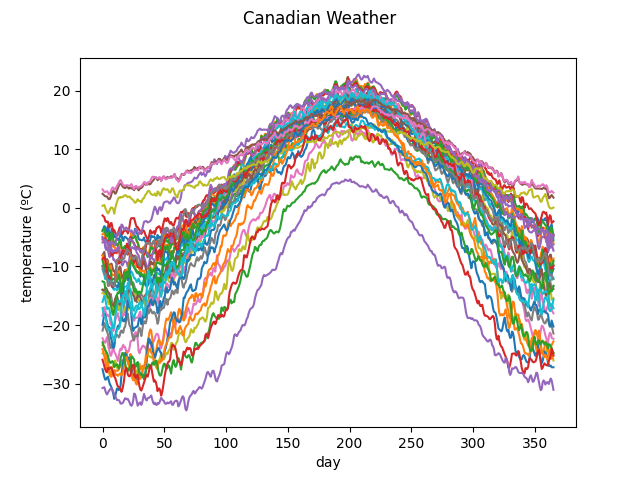
The Canadian weather dataset contains the daily temperature and precipitation at 35 different locations in Canada averaged over 1960 to 1994.
The following figure shows the different temperature and precipitation curves.
from skfda.datasets import fetch_weather

data = fetch_weather()
fd = data["data"]


# Split dataset, temperatures and curves of precipitation
X, y_func = fd.coordinates
Temperatures
import matplotlib.pyplot as plt

X.plot()
plt.show()
Precipitation
y_func.plot()
plt.show()
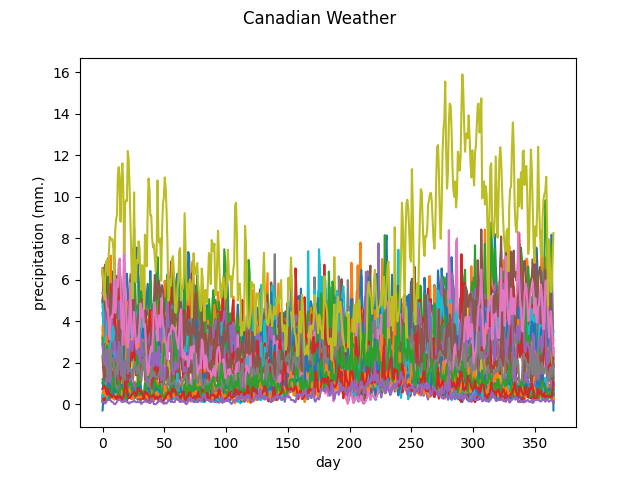
We will try to predict the total log precipitation, i.e, \(logPrecTot_i = \log \sum_{t=0}^{365} prec_i(t)\) using the temperature curves.
[7.30033776 7.28276118 7.29600641 7.14084916 7.0914925  7.02811278
 6.6861106  6.79860983 6.83668883 7.09721794 7.01148446 6.84673058
 6.81640724 6.66262171 6.86484778 6.5572044  6.23284087 6.10724558
 6.01322604 5.91647157 6.0078299  5.89357605 6.14246742 5.99271377
 5.60543435 7.0519422  6.74711693 6.41165405 7.86010789 5.60469852
 5.79209856 5.59136005 6.02707297 5.56106617 4.9698133 ]
As in the nearest neighbors classifier examples, we will split the dataset
in two partitions, for training and test, using the sklearn function
train_test_split().
from sklearn.model_selection import train_test_split

X_train, X_test, y_train, y_test = train_test_split(
    X,
    log_prec,
    random_state=7,
)
Firstly we will try make a prediction with the default values of the estimator, using 5 neighbors and the \(\mathbb{L}^2\) distance.
We can fit the KNeighborsRegressor in the
same way than the
sklearn estimators. This estimator is an extension of the sklearn
KNeighborsRegressor, but accepting a
FDataGrid as input instead of an array
with multivariate data.
from skfda.ml.regression import KNeighborsRegressor

knn = KNeighborsRegressor(weights="distance")
knn.fit(X_train, y_train)
We can predict values for the test partition using
predict().
pred = knn.predict(X_test)
print(pred)
[7.11225785 5.99768933 7.05559273 6.88718564 6.78535172 5.97132028
 6.56125279 6.47991884 6.92965595]
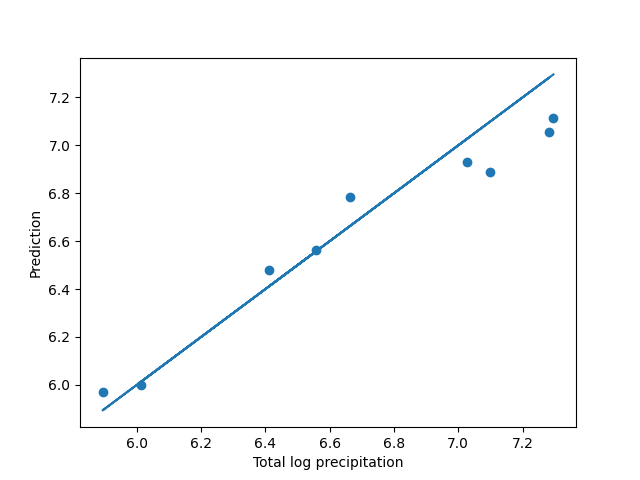
The following figure compares the real precipitations with the predicted values.
fig, ax = plt.subplots()
ax.scatter(y_test, pred)
ax.plot(y_test, y_test)
ax.set_xlabel("Total log precipitation")
ax.set_ylabel("Prediction")

plt.show()
We can quantify how much variability it is explained by the model with
the coefficient of determination \(R^2\) of the prediction,
using score() for that.
The coefficient \(R^2\) is defined as \((1 - u/v)\), where \(u\) is the residual sum of squares \(\sum_i (y_i - y_{pred_i})^ 2\) and \(v\) is the total sum of squares \(\sum_i (y_i - \bar y )^2\).
0.92445585715156
In this case, we obtain a really good aproximation with this naive approach, although, due to the small number of samples, the results will depend on how the partition was done. In the above case, the explained variation is inflated for this reason.
We will perform cross-validation to test more robustly our model.
Also, we can make a grid search, using
GridSearchCV, to determine the optimal
number of neighbors and the best way to weight their votes.
from sklearn.model_selection import GridSearchCV

param_grid = {
    "n_neighbors": range(1, 12, 2),
    "weights": ["uniform", "distance"],
}


knn = KNeighborsRegressor()
gscv = GridSearchCV(
    knn,
    param_grid,
    cv=5,
)
gscv.fit(X, log_prec)
We obtain that 7 is the optimal number of neighbors.
print("Best params", gscv.best_params_)
print("Best score", gscv.best_score_)
Best params {'n_neighbors': 3, 'weights': 'distance'}
Best score -2.521109652461066
More detailed information about the Canadian weather dataset can be obtained in the following references.
Ramsay, James O., and Silverman, Bernard W. (2006). Functional Data Analysis, 2nd ed. , Springer, New York.
Ramsay, James O., and Silverman, Bernard W. (2002). Applied Functional Data Analysis, Springer, New Yorkn’
Total running time of the script: (0 minutes 0.363 seconds)
