


Note
Go to the end to download the full example code. or to run this example in your browser via Binder
Kernel Regression#
In this example we will see and compare the performance of different kernel regression methods.
# Author: Elena Petrunina
# License: MIT
For this example, we will use the
tecator dataset. This data set
contains 215 samples. For each sample the data consists of a spectrum of
absorbances and the contents of water, fat and protein.
from skfda.datasets import fetch_tecator

X_df, y_df = fetch_tecator(return_X_y=True, as_frame=True)
X = X_df.iloc[:, 0].array
fat = y_df["fat"].to_numpy()
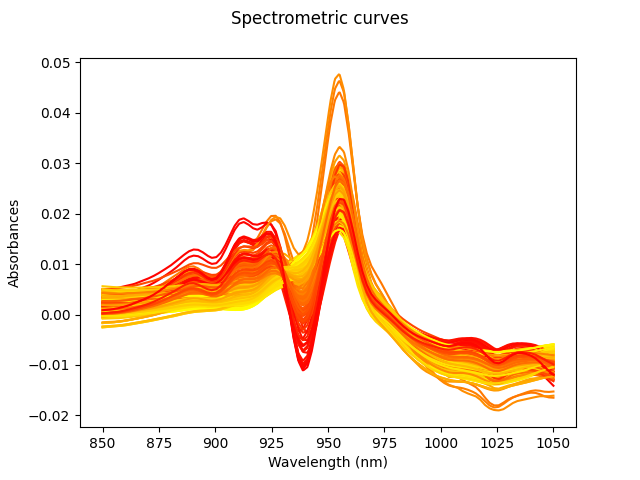
Fat percentages will be estimated from the spectrum. All curves are shown in the image above. The color of these depends on the amount of fat, from least (yellow) to highest (red).

The data set is splitted into train and test sets with 80% and 20% of the samples respectively.
from sklearn.model_selection import train_test_split

X_train, X_test, y_train, y_test = train_test_split(
    X,
    fat,
    test_size=0.2,
    random_state=1,
)
The KNN hat matrix will be tried first. We will use the default kernel function, i.e. uniform kernel. To find the most suitable number of neighbours GridSearchCV will be used, testing with any number from 1 to 100.
import numpy as np
from sklearn.model_selection import GridSearchCV

from skfda.misc.hat_matrix import KNeighborsHatMatrix
from skfda.ml.regression._kernel_regression import KernelRegression

n_neighbors = np.array(range(1, 100))
knn = GridSearchCV(
    KernelRegression(kernel_estimator=KNeighborsHatMatrix()),
    param_grid={"kernel_estimator__n_neighbors": n_neighbors},
)
The best performance for the train set is obtained with the following number of neighbours
knn.fit(X_train, y_train)
print(
    "KNN bandwidth:",
    knn.best_params_["kernel_estimator__n_neighbors"],
)
KNN bandwidth: 3
The accuracy of the estimation using r2_score measurement on the test set is shown below.
Score KNN: 0.3500795818805428
Following a similar procedure for Nadaraya-Watson, the optimal parameter is chosen from the interval (0.01, 1).
from skfda.misc.hat_matrix import NadarayaWatsonHatMatrix

bandwidth = np.logspace(-2, 0, num=100)
nw = GridSearchCV(
    KernelRegression(kernel_estimator=NadarayaWatsonHatMatrix()),
    param_grid={"kernel_estimator__bandwidth": bandwidth},
)
The best performance is obtained with the following bandwidth
nw.fit(X_train, y_train)
print(
    "Nadaraya-Watson bandwidth:",
    nw.best_params_["kernel_estimator__bandwidth"],
)
Nadaraya-Watson bandwidth: 0.37649358067924693
The accuracy of the estimation is shown below and should be similar to that obtained with the KNN method.
Score NW: 0.3127155617541538
For Local Linear Regression, FDataBasis representation with a basis should be used (for the previous cases it is possible to use either FDataGrid or FDataBasis).
For basis, Fourier basis with 10 elements has been selected. Note that the number of functions in the basis affects the estimation result and should ideally also be chosen using cross-validation.
from skfda.misc.hat_matrix import LocalLinearRegressionHatMatrix
from skfda.representation.basis import FourierBasis

fourier = FourierBasis(n_basis=10)

X_basis = X.to_basis(basis=fourier)
X_basis_train, X_basis_test, y_train, y_test = train_test_split(
    X_basis,
    fat,
    test_size=0.2,
    random_state=1,
)


bandwidth = np.logspace(0.3, 1, num=100)

llr = GridSearchCV(
    KernelRegression(kernel_estimator=LocalLinearRegressionHatMatrix()),
    param_grid={"kernel_estimator__bandwidth": bandwidth},
)
The bandwidth obtained by cross-validation is indicated below.
llr.fit(X_basis_train, y_train)
print(
    "LLR bandwidth:",
    llr.best_params_["kernel_estimator__bandwidth"],
)
LLR bandwidth: 4.728762199830451
Although it is a slower method, the result obtained in this example should be better than in the case of Nadaraya-Watson and KNN.
Score LLR: 0.9731955244187162
For this data set using the derivative should give a better performance.
Below the plot of all the derivatives can be found. The same scheme as before is followed: yellow les fat, red more.
Exactly the same operations are repeated, but now with the derivatives of the functions.
K-Nearest Neighbours
knn = GridSearchCV(
    KernelRegression(kernel_estimator=KNeighborsHatMatrix()),
    param_grid={"kernel_estimator__n_neighbors": n_neighbors},
)

knn.fit(Xd_train, y_train)
print(
    "KNN bandwidth:",
    knn.best_params_["kernel_estimator__n_neighbors"],
)

y_pred = knn.predict(Xd_test)
dknn_res = r2_score(y_pred, y_test)
print("Score KNN:", dknn_res)
KNN bandwidth: 4
Score KNN: 0.9428247359478524
Nadaraya-Watson
bandwidth = np.logspace(-3, -1, num=100)
nw = GridSearchCV(
    KernelRegression(kernel_estimator=NadarayaWatsonHatMatrix()),
    param_grid={"kernel_estimator__bandwidth": bandwidth},
)

nw.fit(Xd_train, y_train)
print(
    "Nadara-Watson bandwidth:",
    nw.best_params_["kernel_estimator__bandwidth"],
)

y_pred = nw.predict(Xd_test)
dnw_res = r2_score(y_pred, y_test)
print("Score NW:", dnw_res)
Nadara-Watson bandwidth: 0.006135907273413175
Score NW: 0.9491787548158307
For both Nadaraya-Watson and KNN the accuracy has improved significantly and should be higher than 0.9.
Local Linear Regression
Xd_basis = Xd.to_basis(basis=fourier)
Xd_basis_train, Xd_basis_test, y_train, y_test = train_test_split(
    Xd_basis,
    fat,
    test_size=0.2,
    random_state=1,
)

bandwidth = np.logspace(-2, 1, 100)
llr = GridSearchCV(
    KernelRegression(kernel_estimator=LocalLinearRegressionHatMatrix()),
    param_grid={"kernel_estimator__bandwidth": bandwidth},
)

llr.fit(Xd_basis_train, y_train)
print(
    "LLR bandwidth:",
    llr.best_params_["kernel_estimator__bandwidth"],
)

y_pred = llr.predict(Xd_basis_test)
dllr_res = r2_score(y_pred, y_test)
print("Score LLR:", dllr_res)
LLR bandwidth: 0.010722672220103232
Score LLR: 0.9949460304758446
LLR accuracy has also improved, but the difference with Nadaraya-Watson and KNN in the case of derivatives is less significant than in the previous case.
Total running time of the script: (0 minutes 6.265 seconds)
