


Note
Go to the end to download the full example code. or to run this example in your browser via Binder
Functional Linear Regression with multivariate covariates.#
This example explores the use of the linear regression with multivariate (scalar) covariates and functional response.
# Author: Rafael Hidalgo Alejo
# License: MIT
In this example, we will demonstrate the use of the Linear Regression with
functional response and multivariate covariates using the
weather dataset.
It is possible to divide the weather stations into four groups:
Atlantic, Pacific, Continental and Artic.
There are a total of 35 stations in this dataset.
from skfda.datasets import fetch_weather

X_weather, y_weather = fetch_weather(
    return_X_y=True, as_frame=True,
)
fd = X_weather.iloc[:, 0].array
The main goal is knowing about the effect of stations’ geographic location on the shape of the temperature curves. So we will have a model with a functional response, the temperature curve, and five covariates. The first one is the intercept (all entries equal to 1) and it shows the contribution of the Canadian mean temperature. The remaining covariates use one-hot encoding, with 1 if that weather station is in the corresponding climate zone and 0 otherwise.
import numpy as np
from sklearn.preprocessing import OneHotEncoder

# We first create the one-hot encoding of the climates.
enc = OneHotEncoder(handle_unknown="ignore")
enc.fit([["Atlantic"], ["Continental"], ["Pacific"]])
X = np.array(y_weather).reshape(-1, 1)
X = enc.transform(X).toarray()
Then, we construct a dataframe with each covariate in a different column and the temperature curves (responses).
import pandas as pd

from skfda.representation.basis import FourierBasis

X_df = pd.DataFrame(X)

y_basis = FourierBasis(n_basis=65)
y_fd = fd.coordinates[0].to_basis(y_basis)
An intercept term is incorporated. All functional coefficients will have the same basis as the response.
from skfda.ml.regression import LinearRegression

funct_reg = LinearRegression(fit_intercept=True)
funct_reg.fit(X_df, y_fd)
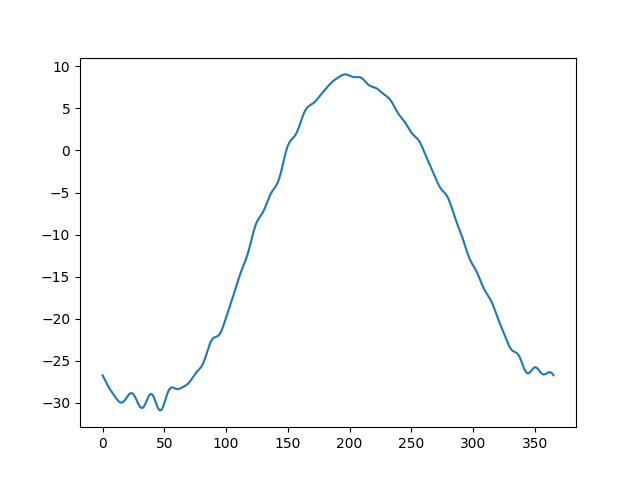
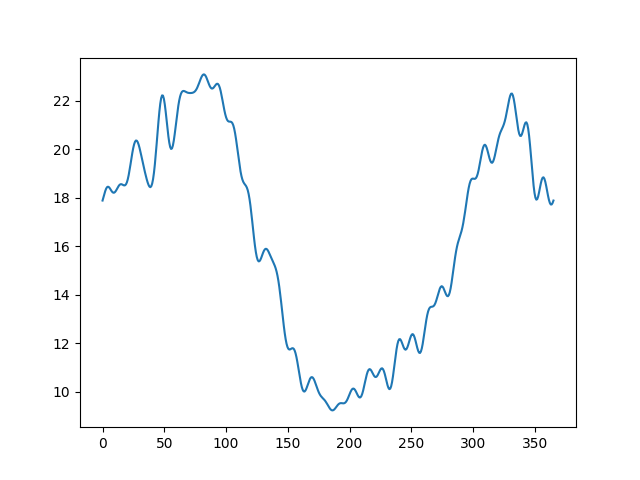
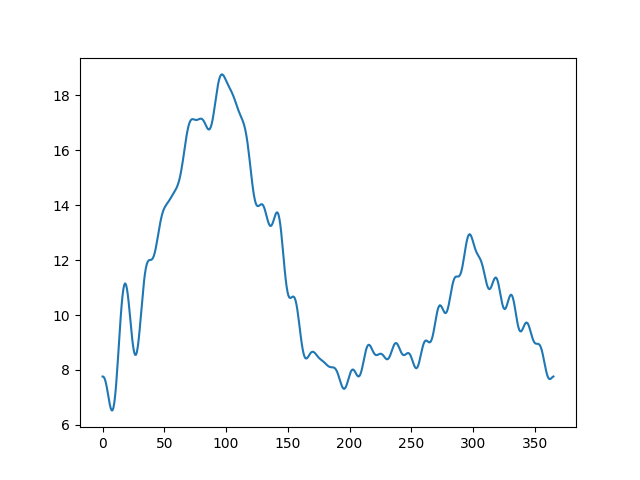
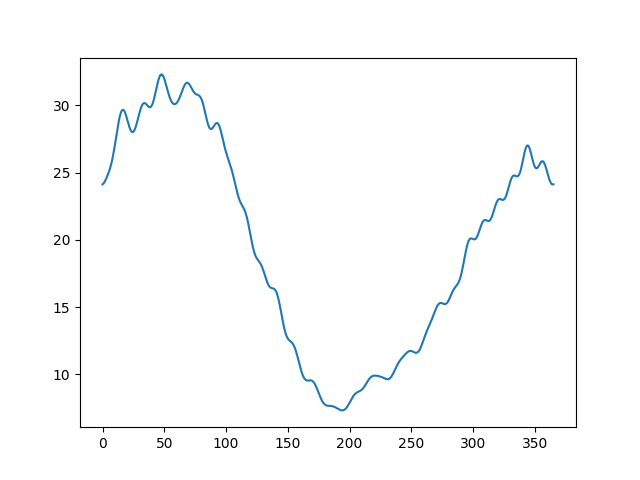
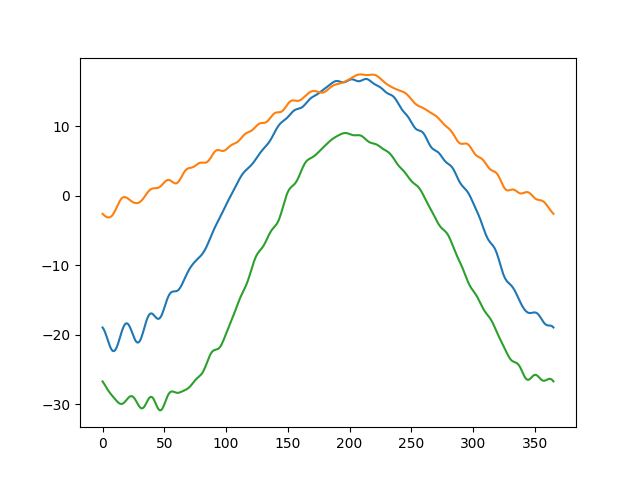
The regression coefficients are shown below. The first one is the intercept coefficient, corresponding to Canadian mean temperature.
import matplotlib.pyplot as plt

funct_reg.intercept_.plot()
funct_reg.coef_[0].plot()
funct_reg.coef_[1].plot()
funct_reg.coef_[2].plot()

plt.show()
Finally, it is shown a panel with the prediction for all climate zones.
X_test = pd.DataFrame(
    [
        [0, 1, 0, 0],
        [0, 0, 1, 0],
        [0, 0, 0, 1],
    ],
)
predictions = funct_reg.predict(X_test)
predictions.plot()

plt.show()
Total running time of the script: (0 minutes 1.990 seconds)
